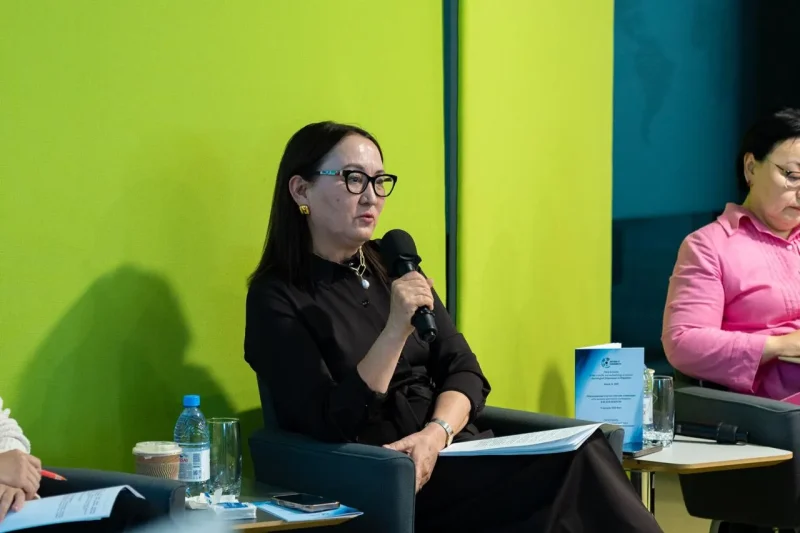
The event featured three speakers who addressed theoretical, educational, and applied aspects of migration.
Aigul Zabirova, Doctor of Sociology, Chief Researcher at the Kazakhstan Institute for Strategic Studies under the President, noted that modern migration is increasingly driven not by poverty but by the pursuit of career opportunities and better living conditions. Classical models are losing relevance, giving way to new concepts that reflect global instability and digital mobility. Special attention was given to the idea of disposable people — the notion of human capital as a rapidly devalued resource.
Kalamkas Yesimova, MA in Anthropology, Senior Researcher at the Institute of Public Opinion, Senior Lecturer at Astana IT University, presented a study on educational migration to South Korea. Despite its attractiveness, students face financial, linguistic, and cultural barriers. Korea’s hierarchical academic and social structure often contrasts with Kazakhstan’s, making adaptation more challenging.
Assem Kusmanova, Ph.D. candidate in Sociology, Senior Lecturer at Astana IT University, spoke on evaluating the state migration program “South–North”. She argued that relying solely on quantitative indicators is insufficient. A full assessment should also include migrants’ motivations, local community responses, and long-term adaptation.
Overall,the seminar highlighted the need for an interdisciplinary approach to migration research, combining quantitative analysis with an understanding of lived human experience.