
Astana IT University
Меню

Навигация

AI and Data Science: Leveraging Responsible AI, Data and Statistics for Practical Impact

AI and Data Science: Leveraging Responsible AI, Data and Statistics for Practical Impact

A collaboration between Astana IT University and MIT IDSS

No. 1
MIT is the world’s No. 1 university in the field of technology (QS World University Rankings, Engineering & Technology)
2 tracks
Complementary tracks: a 12-week program and a 3-day intensive course for executives
2026
Year of Digitalization and Artificial Intelligence in Kazakhstan
1st visit
Visit of the Founder and First Director of MIT IDSS to Kazakhstan

The MIT IDSS Advantage

The MIT Institute for Data, Systems, and Society (IDSS) brings together expertise from Data Science, statistics, information theory, social sciences, and systems engineering to address some of the world’s most complex challenges. Through its research and educational programs, MIT IDSS equips professionals with analytical tools and interdisciplinary frameworks that enable a deeper understanding of interconnected systems.

As part of the 1st ranked university in the world (QS World University Rankings 2025) and 2nd ranked national university in the U.S. (U.S. News & World Report 2025), its commitment to rigorous, application-oriented learning continues to shape how data-driven decisions are made across industries.

Learn from World-Class MIT IDSS Faculty

Learners benefit from access to recorded lectures from MIT faculty and instructors with expertise across deep learning, systems engineering, optimization, causal inference, and more. The program is built on the foundations of MIT IDSS’s research-led approach to education, offering learners the opportunity to engage with ideas that are shaping the future of data-driven decision-making.
Curriculum Powered by Research at LIDS

The Laboratory for Information and Decision Systems (LIDS) forms the research backbone of MIT IDSS. The AI and Data Science: Leveraging Responsible AI, Data and Statistics for Practical Impact program is rooted in MIT’s tradition of applying analytical thinking to real-world challenges. The curriculum integrates foundational and advanced concepts in Data Science, Artificial Intelligence, and Machine Learning, supported by the latest research from LIDS.
Interdisciplinary by Design

MIT IDSS was founded on the belief that solving global challenges requires a fusion of perspectives. The program draws on methods from statistics, control theory, network science, economics, and social sciences, preparing learners to model, analyze, and manage complexity across interconnected systems. This interdisciplinary framework sets the foundation for sustainable innovation in finance, healthcare, urban development, and beyond.
Emphasis on Ethical and Responsible AI

As part of its mission, MIT IDSS prioritizes the responsible design and deployment of AI systems, ensuring learners are equipped to apply Data Science in socially informed, ethically grounded ways.

AI and Data Science: Leveraging Responsible AI, Data and Statistics for Practical Impact

Become an AI-powered decision maker with this 12-week online program delivered by MIT faculty

Online (weekday evenings)
Live/recorded lectures, practice, and mentoring sessions
Offline (weekends)
AITU Disciplines
Practice and Projects
3 projects, real-world cases, and group assignments
Masterclasses on GenAI
3 exclusive sessions

Upon successful completion of the program, participants will receive MIT IDSS certificates.

The official certificate award ceremony will take place at MIT in Boston, USA.

12-week program | Start date: June 22, 2026

Language of instruction: English

AI and Data Science: Leveraging Responsible AI, Data and Statistics for Practical Impact

The 12-week AI and Data Science: Leveraging Responsible AI, Data and Statistics for Practical Impact program (previously called the Data Science and Machine Learning: Making Data Driven Decisions) by MIT IDSS equips you to master the tools, techniques, and perspectives needed to lead in a data-first era and apply cutting-edge solutions to real-world problems. You will explore key topics such as Deep Learning, Computer Vision, Recommendation Systems, and Ethical and Responsible AI.

You will also gain exposure to the latest innovations through three masterclasses on Generative AI, allowing you to understand emerging tools and techniques that are shaping the future of AI-driven solutions. Throughout the program, you will engage in hands-on projects and receive practical guidance from experienced mentors working at leading global organizations. The learning experience is designed to help you connect concepts to real business outcomes and make more informed, impactful decisions.

Program Outcomes

  • Understand the intricacies of Data Science and Artificial Intelligence techniques and their applications to real-world problems
  • Implement various Machine Learning techniques to solve complex problems and make data-driven business decisions
  • Explore two major realms of Artificial Intelligence: Machine Learning and Deep Learning, and understand how they apply to domains such as Computer Vision and Recommendation Systems
  • Choose how to represent your data effectively when making predictions
  • Explore the practical applications of Recommendation Systems across various industries and business contexts
  • Build an industry-ready portfolio of projects and demonstrate your ability to extract valuable business insights from data

Program Benefits

  • Learn from MIT Faculty

    Access recorded lectures from 13 world-renowned MIT faculty and instructors who bring academic depth and industry relevance to every session.
  • Get Mentored by Industry Experts

    Receive direct mentorship from professionals working in the world’s leading organizations as they share real-world applications of Data Science and AI concepts.
  • Real-World Expertise

    Work on 3 hands-on projects and explore over 50 real-world case studies to strengthen your skills and demonstrate your AI and Data Science capabilities.
  • Explore the Future of AI

    Attend 3 exclusive masterclasses on Generative AI to understand the latest developments and how they are shaping industries worldwide.
  • Master Key AI Concepts

    Deepen your understanding of core AI concepts, including Generative AI, Recommendation Systems, Responsible AI, and Deep Learning.
  • Earn a Recognized Credential

    Receive a Certificate of Completion from MIT IDSS and earn 8.0 Continuing Education Units (CEUs), validating your ability to apply AI and Data Science for impact.
  • Career Support

    Benefit from dedicated career support, including tailored CV and LinkedIn profile reviews designed to support your transition or advancement in the field.

Certificate of Completion
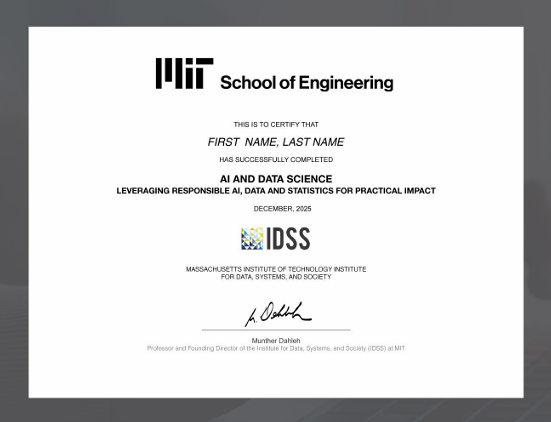
On successful completion of the program, you will receive a Certificate of Completion from MIT IDSS and earn 8.0 Continuing Education Units (CEUs), demonstrating your ability to apply Data Science and Artificial Intelligence in ways that drive measurable value.

Note: The image is for illustrative purposes only. The actual certificate may be subject to change at the discretion of the university.

Who is this Program For?

Professionals looking to build expertise in Data Science, Machine Learning, and AI through hands-on projects and real-world applications.
Individuals seeking to enhance their ability to turn complex data into actionable insights for better business decisions.
Professionals aiming to lead or contribute to AI and Data Science initiatives across industries.
Professionals interested in applying advanced AI techniques like GenAI, Deep Learning, and Recommendation Systems to solve business challenges.

Program Curriculum

This 12-week program is designed to help you build a strong foundation in Data Science, Machine Learning, and Artificial Intelligence through structured, application-oriented learning.

30+ hours of recorded lectures from MIT faculty, mentored sessions with experts, and hands-on projects, structured as follows:

Pre-work

Foundations of Data Science and AI

• Introduction to the World of Data
• Introduction to Python
• Introduction to Generative AI
• Introduction to Prompt Engineering
• Applications of Data Science and AI


• Data Science Lifecycle
• Mathematics and Statistics behind Data Science and AI
• History of Data Science and AI

Week 0

Data Science and AI Applications

• Data Science and Artificial Intelligence Application Case Study

Week 1-2

Foundations of AI

• Python for Data Science(NumPy & Pandas)
• Python for Visualization


• Inferential Statistics
• Hypothesis Testing

Week 3

Masterclass on Data Analysis with Generative AI

Week 4

Making Sense of Unstructured Data

• Clustering
• Dimensionality Reduction techniques (PCA, t-SNE)

Week 5

Project Week and GenAI Masterclass

• Project on Clustering and PCA
• Masterclass on Learning from Text Data

Week 6

Regression and Prediction

• Introduction to Supervised Learning and Regression


• Model Evaluation, Cross-Validation, and Bootstrapping

Week 7

Classification and Hypothesis Testing

• Introduction to Classification
• Hypothesis Testing


• Logistic Regression
• Decision Trees and Random Forest

Week 8

Project Week and GenAI Masterclass

• Project on Machine Learning Classification
• Masterclass on AI-Powered Text Labeling

Week 9

Deep Learning and Computer Vision

• Introduction to Deep Learning
• The Concept of Neurons
• Artificial Neural Networks (ANNs)


• Introduction to Computer Vision
• CNN Architecture and Transfer Learning

Week 10

Recommendation Systems

• Recommendation Systems
• Recommendation Systems - Clustering, Collaborative Filtering & SVD

Week 11

Ethical and Responsible AI

• Introduction to AI Lifecycle
• Introduction to Bias and its Examples
• Introduction to Causality and Privacy


• Interconnections and Domains
• Interdependency and Feedback in AI Systems

Week 12

Project Week

• Project on Recommendation System
* Program completion criteria: Candidates must score a minimum of 60% in each course.

Self-Paced Modules

Module 1
Generative AI Foundations
Module 2
Business Applications of Generative AI (Includes introduction to Agentic AI)
Module 3
Networking and Graphical Models
Module 4
Predictive Analytics

Program Faculty

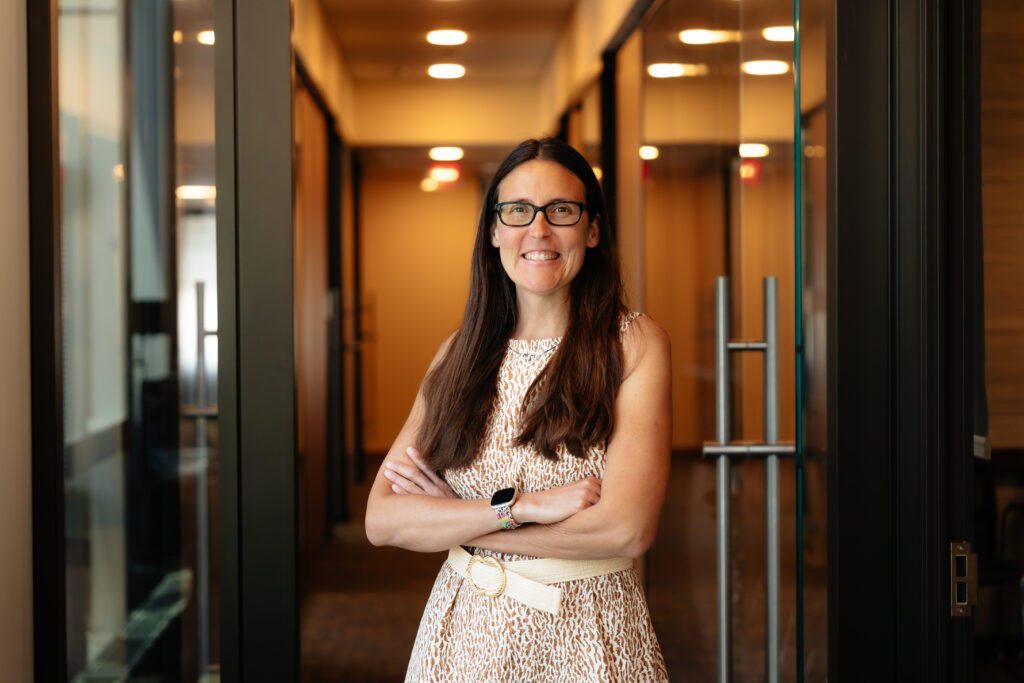
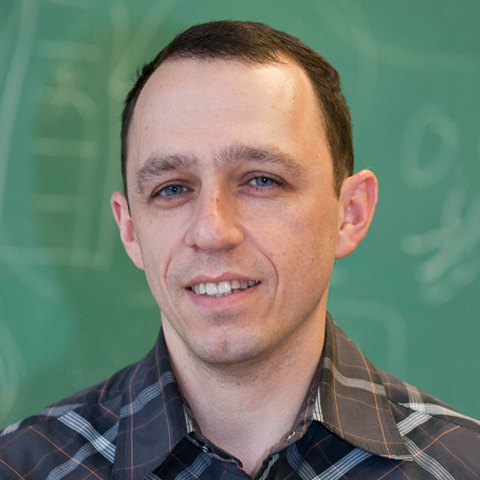
Dr. Caroline Uhler
Faculty member at MIT
Dr. Caroline Uhler
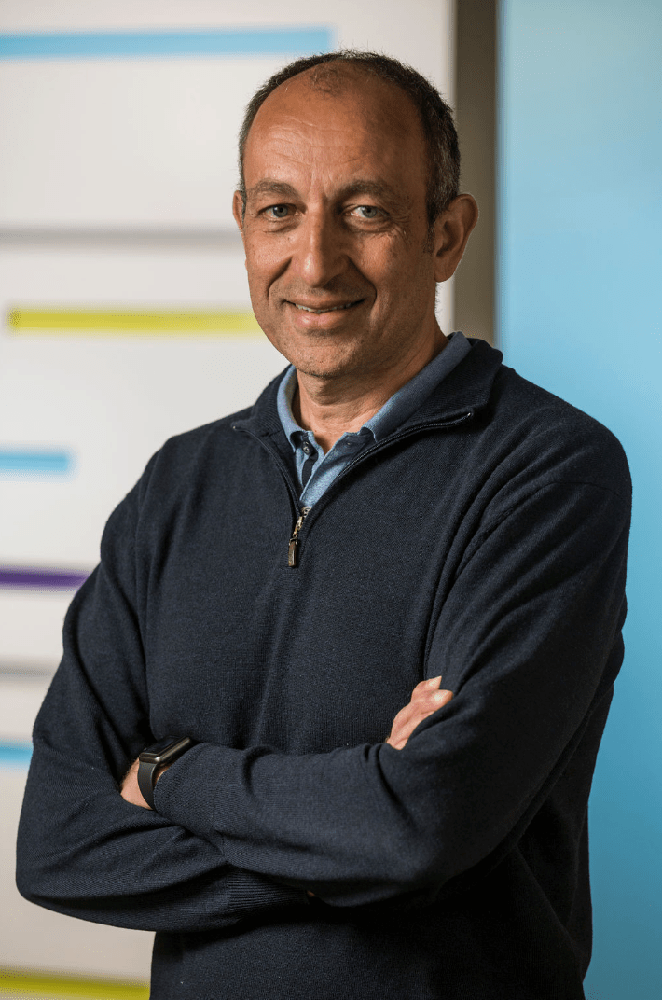
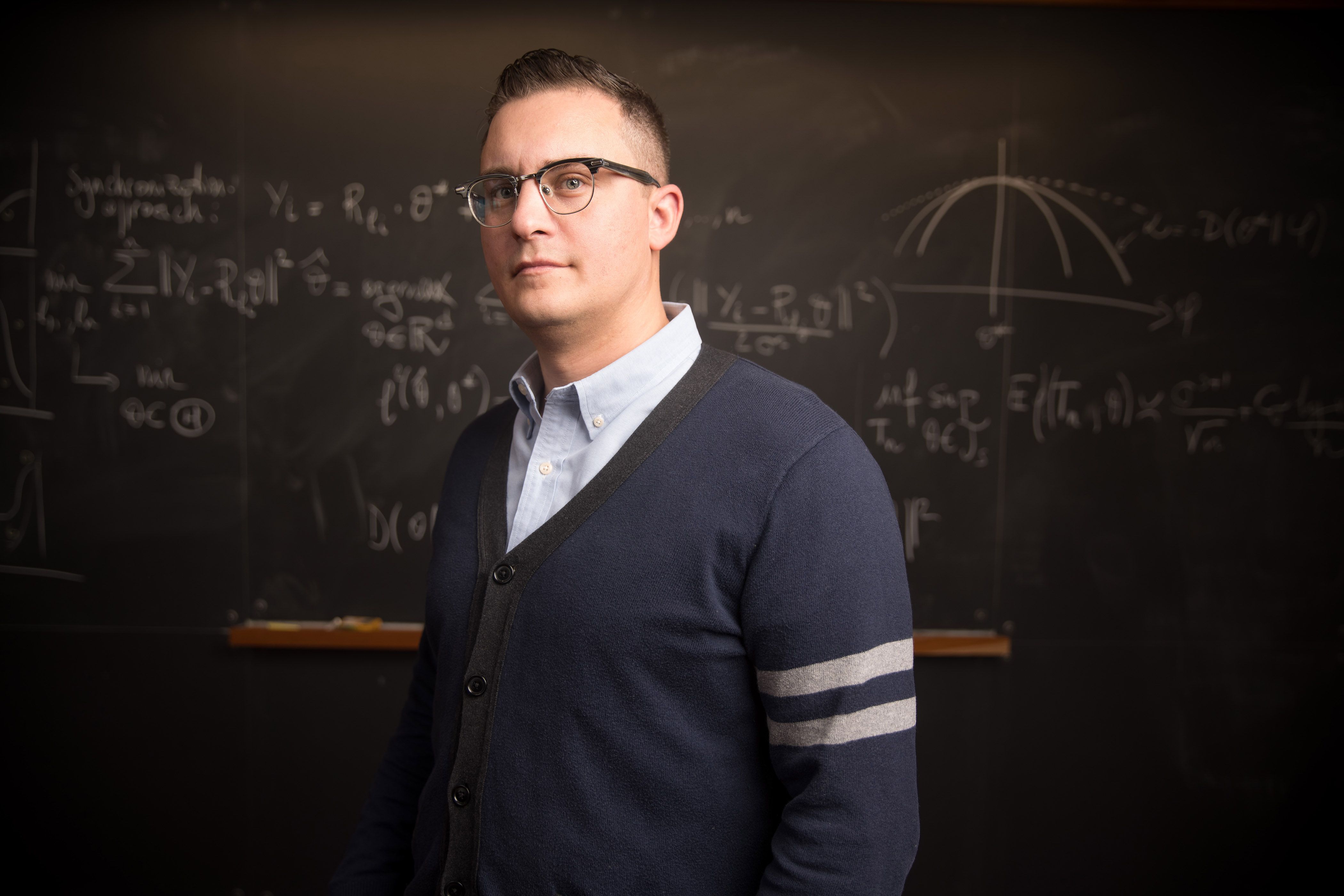
Prof. Munther Dahleh
Professor at MIT
Prof. Munther Dahleh
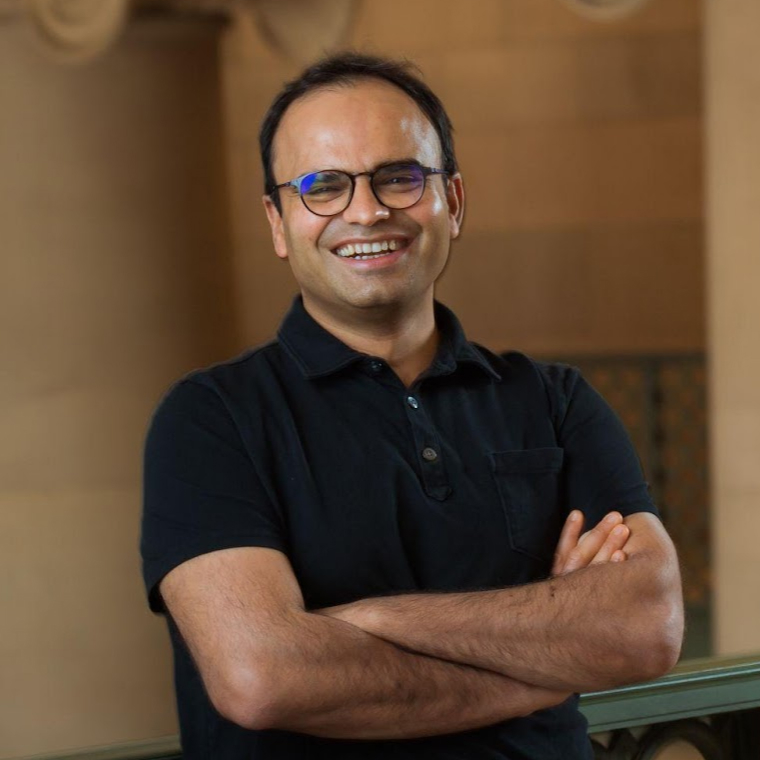
Dr. Devavrat Shah
Professor at MIT
Dr. Devavrat Shah
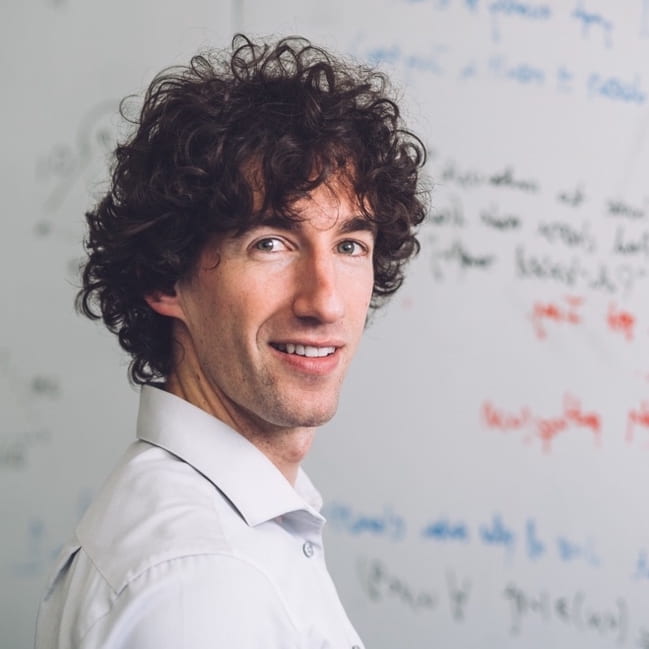
Prof. Stefanie Jegelka
Associate Professor at MIT
Prof. Stefanie Jegelka
Prof. John Tsitsiklis
Professor at MIT
Prof. John Tsitsiklis
Dr. Caroline Uhler is a faculty member at MIT with joint appointments in Electrical Engineering and Computer Science (EECS) and the Institute for Data, Systems, and Society (IDSS). Dr. Uhler’s research lies at the intersection of Machine Learning, statistics, and genomics, with a particular focus on causal inference, representation learning, and gene regulation. She holds a Ph.D. in Statistics from the University of California, Berkeley, along with degrees in Mathematics, Biology, and Mathematics Education. Dr. Uhler is an elected member of the International Statistical Institute and the recipient of several prestigious honors, including a Sloan Research Fellowship, an NSF CAREER Award, the Sofja Kovalevskaja Award from the Humboldt Foundation, and the START Award from the Austrian Science Fund.
Prof. Munther Dahleh is a prominent figure in the MIT academic community, holding the position of William A. Coolidge Professor. He was the founding director of the Institute for Data, Systems, and Society (IDSS), serving from July 1, 2015, to June 30, 2023. He is also a member of the MIT Laboratory for Information and Decision Systems (LIDS). Prof. Dahleh began his academic journey at MIT in 1987 as an assistant professor and was promoted to full professor in 1998. His research spans robust control theory, computational controller design, the relationship between information and control, and systemic risk in interconnected systems. He is internationally recognized for his contributions to these domains and has served as a visiting professor at Caltech and a consultant to several organizations worldwide.
Dr. Devavrat Shah Dr. Devavrat Shah is the Andrew (1956) and Erna Viterbi Professor in the Department of Electrical Engineering and Computer Science at MIT. He is also affiliated with the Laboratory for Information and Decision Systems (LIDS), the Institute for Data, Systems, and Society (IDSS), and the Operations Research Center (ORC).. He earned his Ph.D. in Computer Science from Stanford University. His research focuses on large-scale networks and inference, including stochastic networks, network algorithms, and network information theory. Over the years, Dr. Shah has received several prestigious accolades, such as the President of India Gold Medal, the INFORMS George B. Dantzig Best Dissertation Award, the ACM SIGMETRICS Rising Star Award, and the Erlang Prize from INFORMS. He was also honored as a Distinguished Young Alumnus by IIT Bombay. He co-founded Celect, Inc., which was acquired by Nike in 2019, and later co-founded Ikigai Labs to support data-driven decision-making in businesses.
Prof. Stefanie Jegelka is an Associate Professor in the Department of Electrical Engineering and Computer Science at MIT. She is affiliated with the Computer Science and Artificial Intelligence Laboratory (CSAIL), the Institute for Data, Systems, and Society (IDSS), and MIT’s Machine Learning group. Her research spans algorithms, optimization, and Machine Learning, with a focus on combinatorial and discrete problems in modern AI systems. Prior to joining MIT, she was a postdoctoral researcher at the AMPlab and the Computer Vision Group at the University of California, Berkeley. She earned her Ph.D. at the Max Planck Institute in Tübingen and ETH Zurich. Prof. Jegelka is recognized for her innovative contributions to the theoretical foundations of Machine Learning.
Prof. John Tsitsiklis is an esteemed faculty member in the MIT Department of Electrical Engineering and Computer Science. He is associated with the MIT Institute for Data, Systems, and Society (MIT IDSS), the MIT Laboratory for Information and Decision Systems (MIT LIDS), and the MIT Operations Research Center (MIT ORC). His research covers optimization, control, learning, and decentralized decision-making. He is the co-author of several foundational texts, including Parallel and Distributed Computation, Neuro-Dynamic Programming, Introduction to Linear Optimization, and Introduction to Probability. Prof. Tsitsiklis is the recipient of multiple prestigious honors, including the ACM SIGMETRICS Achievement Award, the INFORMS John von Neumann Theory Prize, and the IEEE Control Systems Award. He also holds honorary doctorates from Université Catholique de Louvain, Athens University of Economics and Business, and Harokopio University. He received his B.S. in Mathematics, M.S., and Ph.D. in Electrical Engineering, all from MIT.

Learners will also get access to supporting content from the following MIT faculty members
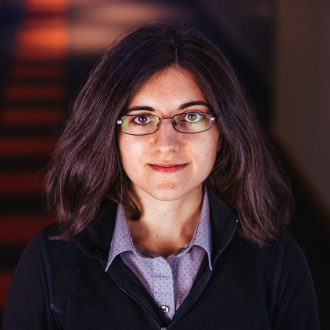
Prof. Tamara Broderick
Associate Professor, Department of Electrical Engineering & Computer Science, MIT
Prof. Victor Chernozhukov
Professor, Department of Economics, Massachusetts Institute of Technology (MIT)
Prof. David Gamarnik
Nanyang Technological University Professor of Operations Research, MIT Sloan School of Management
Prof. Jonathan Kelner
Professor of Applied Mathematics, MIT Department of Mathematics
Dr. Philippe Rigolle
Professor of Mathematics, Massachusetts Institute of Technology (MIT)
Prof. Guy Bresler
Prof. Guy Bresler
Associate Professor, Department of Electrical Engineering and Computer Science, MIT
Dr. Kalyan Veeramachaneni
Principal Research Scientist, Laboratory for Information and Decision Systems (LIDS), Massachusetts Institute of Technology (MIT)
Prof. Ankur Moitra
Prof. Ankur Moitra
International Career Development Professor, Applied Mathematics and IDSS, MIT

AITU Mentors — support at every stage

• Individual consultations
• Feedback
• Project support
• Career guidance

Astana IT University